
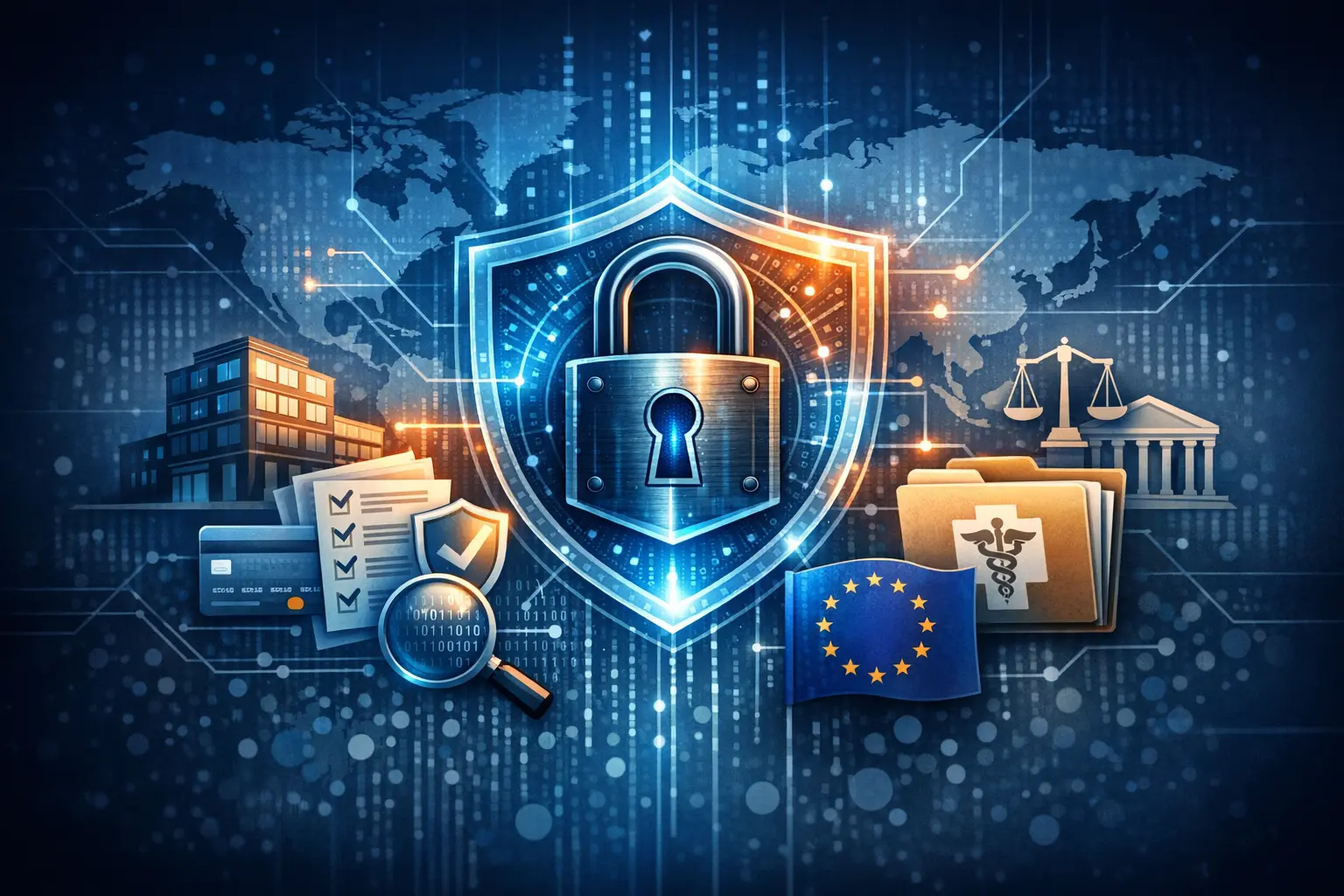
Small Businesses and Cybersecurity Compliance
With an ever-evolving digital threat landscape, cybersecurity compliance is critical for all businesses. Small businesses rarely have the same cybersecurity budget as large organizations, yet they are just as much a target for cybercriminals. There are many cybersecurity laws, standards, and frameworks that a small business may need to comply with. Managed service providers (MSPs) can help reduce the burden of compliance by assisting with implementing security controls and providing guidance for policies and procedures.
Common Standards and Regulations
Payment Card Industry Data Security Standard (PCI DSS)
One of the most common cybersecurity standards that small businesses must adhere to is PCI DSS, which is maintained by the PCI Security Standards Council and enforced by major card brands. If your business handles Credit and Debit card information in any way, your payment processor will require you to be PCI DSS compliant. Compliance is divided into four levels based on an organization’s annual transaction volume and has twelve security requirements.
These are PCI DSS’s twelve requirements:
1. Install and Maintain Network Security Controls
2. Apply Secure Configurations to All System Components
3. Protect Stored Account Data
4. Protect Cardholder Data with Strong Cryptography During Transmission over Open, Public Networks
5. Protect All Systems and Networks from Malicious Software
6. Develop and Maintain Secure Systems and Software
7. Restrict Access to System Components and Cardholder Data by Business Need to Know
8. Identify Users and Authenticate Access to System Components
9. Restrict Physical Access to Cardholder Data
10. Log and Monitor All Access to System Components and Cardholder Data
11. Test the Security of Systems and Networks Regularly
12. Support Information Security with Organizational Policies and Programs
Implementing security controls, such as firewalls, antivirus software, and user authentication, is something a managed IT service provider can assist with to help you meet PCI DSS requirements.
Cybersecurity Maturity Model Certification (CMMC)
If a business contracts with a department or agency of the United States government, it must comply with the CMMC Program. The CMMC program was created by the Department of War (DoW) and is designed to protect Federal Contract Information (FCI) and Controlled Unclassified Information (CUI). There are three levels of compliance with CMMC, and the level a business must adhere to is determined by the type of data handled for the government.
These are the three levels of CMMC:
- Level 1
- Meant to protect FCI
- 15 requirements
- Compliance is determined through an annual self-assessment of security controls.
- Level 2
- Meant to protect FCI and CUI
- 110 requirements
- Compliance is determined through a third-party assessment of security controls.
- Level 3
- Meant to protect FCI and CUI
- 134 requirements
- Compliance is determined through a government-led assessment of security controls.
Access Control is the first major requirement area at each CMMC level. By leveraging managed IT, a service provider can help implement controls such as user authentication and the principle of least privilege. The principle of least privilege is important because it ensures that users, processes, and applications are granted only the permissions necessary to perform their tasks, thereby reducing security risks.
Systems and Organization Controls 2 (SOC 2)
The SOC 2 security framework helps an organization ensure it has appropriate security measures in place to handle sensitive customer data. SOC 2 is meant for organizations that store, process, or transmit customer data. It is very commonly used to ensure that a Cloud or SaaS provider has appropriate security controls in place.
The SOC 2 requirements are built around these five criteria:
· Security: Safeguards against unauthorized access through security controls such as firewalls or Multi-Factor Authentication (MFA).
· Availability: Ensuring systems are operational and accessible as promised.
· Processing Integrity: Ensuring data processing is accurate and on time.
· Confidentiality: Protecting sensitive data via encryption and access controls.
· Privacy: Governs how personal data is collected, used, stored, and shared in accordance with policies and regulations.
While it may seem normal for a Cloud or SaaS organization to manage IT internally, utilizing a managed IT service provider makes sense because it allows the organization to focus more on the services it provides. Working with an MSP to manage user accounts, implement security controls, and monitor systems reduces the burden of compliance on the organization.
Health Insurance Portability and Accountability Act (HIPAA)
HIPAA is a legal framework for organizations and individuals that handle protected health information (PHI). PHI includes medical records, billing data, and personal identifiers such as names and Social Security Numbers. HIPAA is comprehensive, including provisions that govern the electronic exchange, privacy, and security of PHI. HIPAA’s framework includes multiple rules that each govern different aspects of how businesses should handle PHI. These rules include:
· The Privacy Rule establishes the national standard for protecting patients’ PHI and governs its use and disclosure.
· The Security Rule sets national standards for the secure maintenance, transmission, and handling of PHI, including access controls, encryption, and audit logs.
· The Breach Notification Rule establishes the standards for responding to a data breach involving PHI, including notifying affected patients, the public, and the Department of Health and Human Services.
Some HIPAA requirements can be easy to overlook when you manage your own IT, such as ensuring data is encrypted at rest. Many organizations may not realize that workstations running Windows Home don’t natively encrypt all data, whereas Windows Pro automatically enables full device encryption when properly configured. This is something that an MSP like Lean On Me I.T. can help identify and correct, ensuring that your organization adheres to HIPAA’s requirements.
General Data Protection Regulation (GDPR)
The GDPR is a data protection law enacted by the European Union (EU) that mandates strict protection, privacy, and security of personal data within the EU. Although it is EU law, it applies to businesses worldwide that handle data of EU residents. GDPR’s key requirements include obtaining explicit user consent, ensuring data accuracy and security, limiting data retention, and allowing individuals to access or erase their data. If a business is subject to GDPR compliance, managed IT can help implement security controls and may be able to provide guidance on complying with other requirements.
Why Compliance Is Important
· Compliance ensures the protection of sensitive data and builds customer trust. Failing to protect sensitive data often results in significant reputational damage.
· Often, compliance with regulations or standards is required, whether by law or by contract. Failure to maintain compliance can result in severe legal consequences, financial penalties or losses, and reputation damage.
· Business continuity is critical, and the consequences of noncompliance can include system downtime, financial penalties, and reputation damage. Any of these may be enough to put an organization out of business.
Steps to Achieve and Maintain Compliance
1. Identify which standards and regulations your business is subject to.
2. Conduct a risk assessment to evaluate your business’s security posture and identify areas that need improvement to meet compliance.
3. Implement security measures to protect systems and sensitive information; employee training is just as critical as installing firewalls and antivirus software.
4. Create and maintain policies and procedures that outline your compliance strategy, incident response, and employee responsibilities.
5. Review and update security measures regularly to keep up with ever-evolving cyber threats.
Cyber Insurance
No organization can ever be 100% secure. There will always be some risk, so businesses need to be prepared to deal with the aftermath of an incident. One of the best ways to ensure business continuity in the event of a cybersecurity incident is cyber insurance. Cyber insurance, or cyber liability insurance, is a specialized policy designed to protect individuals and businesses from financial losses, legal fees, and recovery costs arising from cyberattacks, such as data breaches or ransomware.
Policies typically cover first-party losses, which are the immediate costs to the organization, and third-party liabilities, such as lawsuits or regulatory fines. Normally, maintaining a cyber insurance policy will require an organization to have reasonable security controls in place. Much like with common standards and regulations, these controls can include MFA, immutable data backups, and endpoint detection and response (EDR) systems.
Conclusion
Complying with the many laws, regulations, and standards that may apply to your business can be quite the undertaking and may seem overbearing, but you don’t have to do it alone. Managed IT service providers, such as Lean On Me I.T., can help you implement many of the security controls that will help you adhere to the laws and regulations that apply to your business.